
Clark-type polarographic electrodes for high-resolution respirometry.
Clark-type oxygen electrodes remain an essential tool in the investigation of mitochondrial function (Li & Graham, 2012) (Paital & Samanta, 2013), bridging the gap between classical biochemistry and cutting-edge biomedical techniques. Paired with an oxygen electrode control unit, such as the Oxygraph+ and Oxytherm+ R, the simplicity, robustness, and cost-effectiveness, coupled with real-time visual tracking of oxygen consumption, make Clark-type oxygen electrode-based respirometers accessible for a wide range of researchers and institutions.
Clark-type oxygen electrodes are incredibly versatile, allowing measurements of respiration in isolated mitochondria, intact cells, and tissue homogenates. They provide direct, quantitative insights into key mitochondrial processes such as oxidative phosphorylation (OXPHOS), substrate utilisation, and the effects of pharmacological agents. The measurement of oxygen consumption is pivotal in assessing mitochondrial function, because oxygen is the terminal electron acceptor in the electron transport chain, and its consumption directly correlates with ATP production during OXPHOS (Li & Graham, 2012) (Silva & Oliveira, 2012).

For studies involving mitochondrial dysfunction, the Clark oxygen electrode is invaluable in detecting subtle changes in oxygen consumption rates associated with pathological conditions, including neurodegenerative diseases and metabolic disorders. The robust design and simplicity of operation make it accessible to both novice and experienced researchers, while its ability to integrate with modern software enhances data acquisition and analysis.
The Hansatech Instruments oxygen electrode consists of a platinum cathode and silver anode set into an epoxy resin disc. The oxygen electrode is prepared for use by trapping a layer of 50% saturated KCl electrolyte solution beneath an oxygen-permeable PTFE membrane. A paper spacer placed beneath the membrane acts as a wick to provide a uniform layer of electrolyte between the anode and cathode. When a small voltage is applied across these electrodes, the current which flows is at first negligible and the platinum cathode becomes polarised with respect to the silver anode. As this potential is increased to 700 mV, oxygen is reduced at the platinum surface, initially to hydrogen peroxide (H2O2), so that the polarity tends to discharge as electrons are donated to oxygen (which acts as an electron acceptor). The current which then flows is stoichiometrically related to the oxygen consumed at the cathode (Walker, 1987).
Hansatech Instruments oxygen electrode systems for respirometry
The Oxygraph+ and Oxytherm+ R high-resolution respirometry systems are valuable tools for studying cellular metabolism where the investigation of subtle changes in mitochondrial respiration or enzymatic activity are required.
These highly sensitive systems provide a straightforward setup for many different types of respirometry assay. Within the data acquisition software, oxygen concentration and oxygen flux are plotted at user-defined acquisition rates offering a highly convenient, user-friendly display of the experiment. The ability to observe data acquisition in real-time, allows researchers to closely monitor the oxygen flux after the addition of substrates, inhibitors and uncouplers and, if necessary, react rapidly to modify the experimental process.
Additionally, the signal from a pH probe electrode, or other ion selective electrodes (ISEs), can be recorded. This allows researchers to closely monitor changes in oxygen flux alongside pH levels and other key indicators of mitochondrial function such as membrane potential (TPP+), Calcium (Ca2+) and potassium (K+) activity. The ISEs, and where necessary, a reference electrode, connect directly to the Oxygraph+ or Oxytherm+ R instruments providing a convenient, compact solution for any lab.
For complete flexibility, up to 8 individual instruments can be operated as a multi-channel system. This allows researchers to perform multiple assays simultaneously on either different sample types or under different conditions (such as pH or temperature).
High-resolution respirometry products
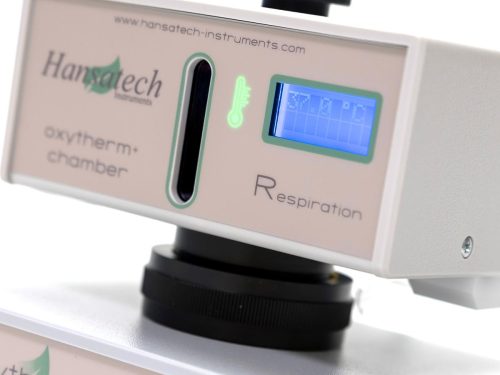
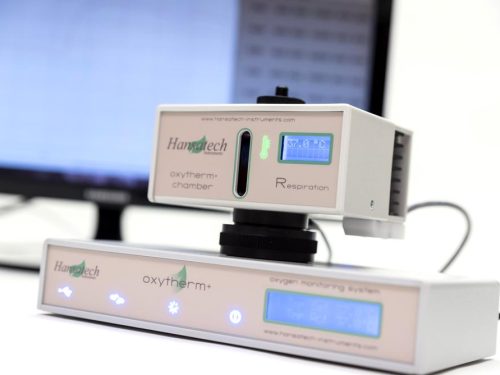
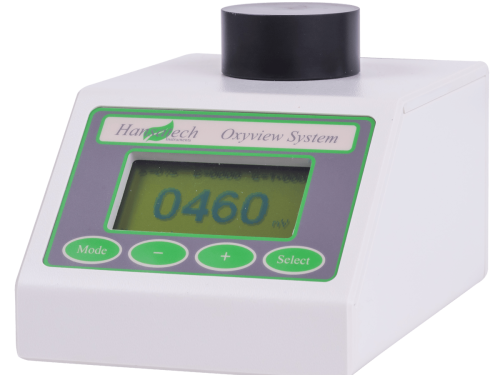
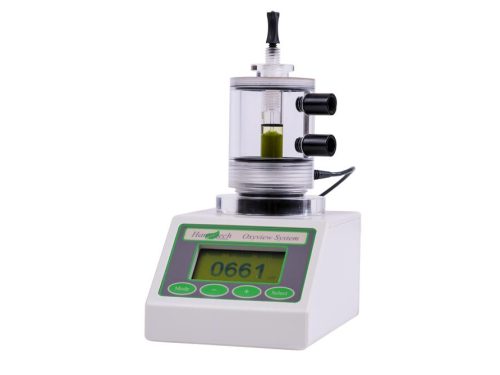
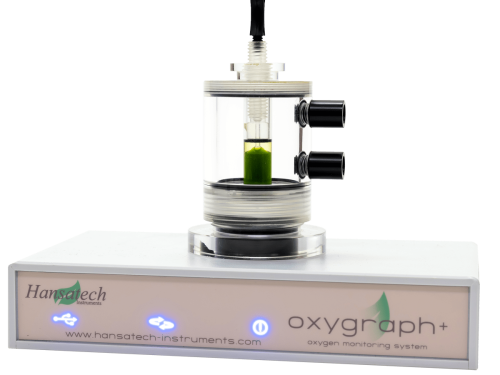
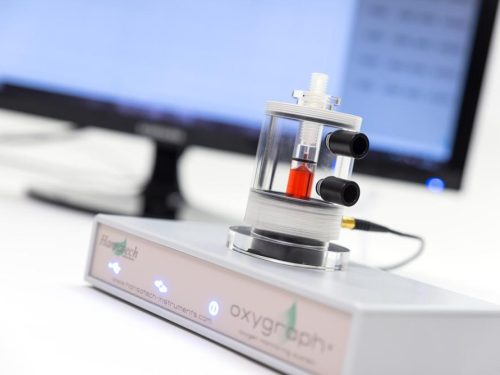
Oxygraph+ and Oxytherm+ R respirometers measure within a sealed sample chamber, preventing ingress of atmospheric oxygen. This is crucial for a sensitive, accurate system capable of detecting small changes in oxygen flux with no interference (Levitsky et al., 2019) (Quetin & Mickel, 1983). The closed system design ensures stable conditions, making it ideal for high-resolution kinetic studies of mitochondrial bioenergetics.
With an Oxygraph+ or Oxytherm+ R respirometer, there are lower ongoing costs due to the straight-forward maintenance and operation. Additionally, they may be used for longer experimental runs without extensive cleaning between assays. This may reduce reagent waste and overall expenses, when compared with other systems that use microplate technology. Microplate devices have expensive, disposable sensor cartridges and sophisticated workflows requiring more frequent cleaning and calibration (Divakaruni et al., 2014). While other technologies may provide a broader metabolic overview, the Oxygraph+ and Oxytherm+ R are better choices for detailed mitochondrial-focused research and when resources are constrained.
References
Distinguishing cellular respiration vs. oxidative stress in turbid media using UV-excited autofluorescence spectroscopy.
Paul, Urayama., Taylor, Phillips., Thomas, A., Finn., Bibek, Dhakal., Karthik, Vishwanath.
Label-free Biomedical Imaging and Sensing (LBIS) 2021. Vol. 11655. SPIE, 2021.
Measurement of mitochondrial oxygen consumption using a Clark electrode.
Li, Zhihong, and Brett H. Graham.
Mitochondrial Disorders: Biochemical and Molecular Analysis (2012): 63-72.
https://doi.org/10.1007/978-1-61779-504-6_5
A comparative study of hepatic mitochondrial oxygen consumption in four vertebrates by using Clark-type electrode.
Paital, B., and Luna Samanta.
Acta Biologica Hungarica 64 (2013): 152-160.
https://doi.org/10.1556/ABIOL.64.2013.2.2
The use of the oxygen electrode and fluorescence probes in simple measurements of photosynthesis.
Walker, David.
Sheffield: Research Institute for Photosynthesis, University of Sheffield, 1987.
Link to a digital copy of this book
Micro-respirometry of whole cells and isolated mitochondria
Yan, Levitsky., David, Pegouske., Sandra, S, Hammer., Nathan, L., Frantz., Kiera, Fisher., Artem, Muchnik., Anand, R., Saripalli., Philip, Kirschner., Jason, N., Bazil., Julia, V., Busik., Denis, A., Proshlyakov.
RSC advances 9.57 (2019): 33257-33267.
https://doi.org/10.1039/C9RA05289E
Sealed respirometers for small invertebrates.
Quetin, L. B., and T. J. Mickel.
Polarographic Oxygen Sensors: Aquatic and Physiological Applications.
Berlin, Heidelberg: Springer Berlin Heidelberg, 1983. 184-189.
https://doi.org/10.1007/978-3-642-81863-9_17
Evaluation of respiration with clark type electrode in isolated mitochondria and permeabilized animal cells.
Silva, Ana M., and Paulo J. Oliveira.
Mitochondrial Bioenergetics: Methods and Protocols (2012): 7-24.
https://doi.org/10.1007/978-1-61779-382-0_2
Measuring mitochondrial function in permeabilized cells using the seahorse XF analyzer or a clark‐type oxygen electrode.
Divakaruni, Ajit S., George W. Rogers, and Anne N. Murphy.
Current protocols in toxicology 60.1 (2014): 25-2.
https://doi.org/10.1002/0471140856.TX2502S60
